Micro Paludariums
Mastering the convergence of aquatic and terrestrial biomes in tightly constrained glass structures.
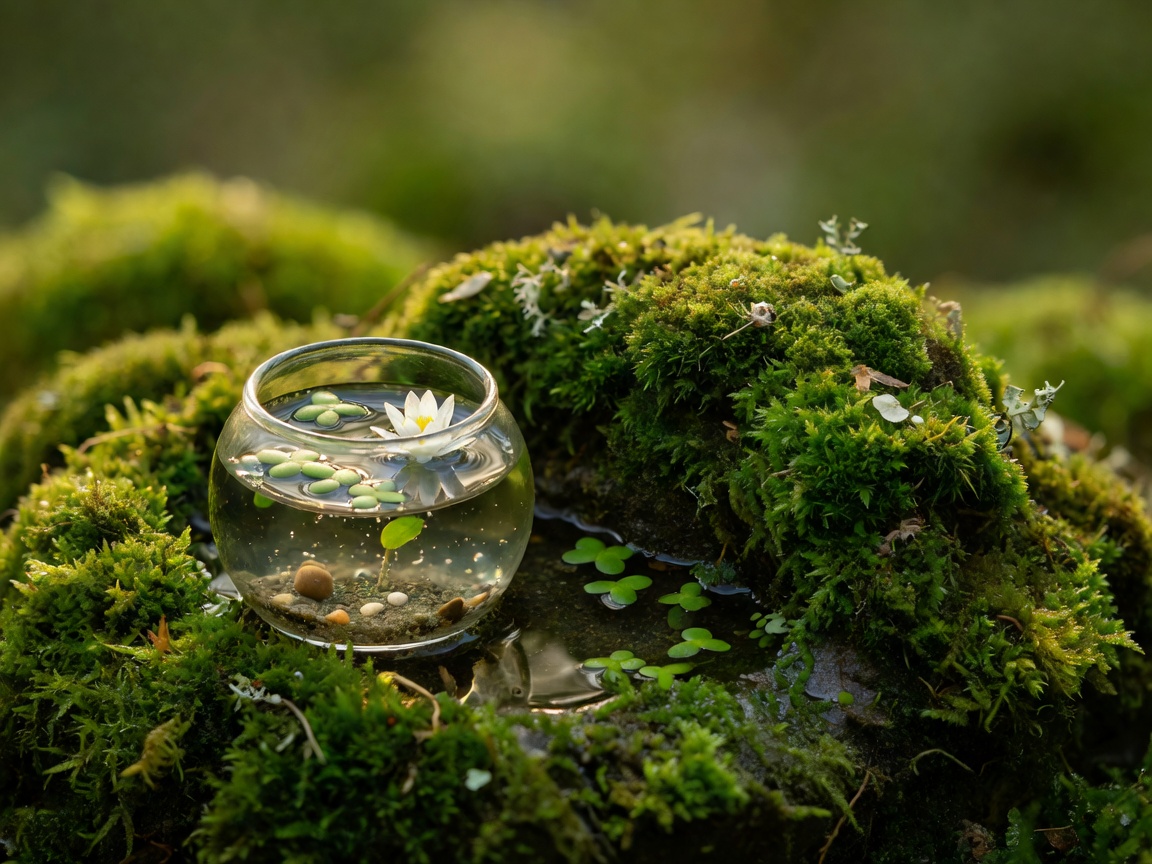
The Land-Water Interface
A paludarium incorporates both terrestrial and aquatic elements, modeling a riparian zone (the interface between land and a river or stream). In macro designs, these systems use pumps and complex filtration to maintain water quality. Scaling this down to a micro-paludarium (often built in containers smaller than five liters) requires relying entirely on passive wicking, biological filtration, and precise material selection.
The core challenge is preventing the terrestrial section from becoming waterlogged and anoxic, while keeping the aquatic section clear of excessive soil run-off. This necessitates structural barriers—often constructed from inert materials like slate, porous volcanic rock, or specialized synthetic mesh—that divide the zones while allowing moisture to permeate slowly.
Capillary Action and Zonation
Because there is no active pump in a closed or low-tech micro-paludarium, moisture distribution relies on capillary action. The substrate must pull water upwards against gravity to sustain the land plants without fully submerging their roots.
- The Aquatic Zone: Filled with coarse sand or fine gravel, this area functions as a biological filter. Aquatic plants like Anubias or Java Fern can be attached to hardscape here, absorbing nitrates directly from the water column.
- The Transition Zone: This is the barrier wall. Materials like porous foam or cork bark act as a sponge, pulling water upward. Amphibious mosses (like Java moss) thrive here, growing directly out of the water and onto the land.
- The Terrestrial Zone: Elevated above the water table, containing a well-draining soil mix. Roots may reach down toward the transition zone, but the crown of the plant remains aerated.
Preventing Stagnation
Stagnant water is the enemy of the micro-paludarium. Without flow, the surface can develop a biofilm that severely limits gas exchange, leading to anoxic conditions in the aquatic zone. To counter this in pump-less systems, architectural design plays a critical role. Emersed plant growth—plants whose roots are in the water but leaves are in the air—breaks the surface tension and acts as biological water purifiers.
Micro-Fauna Dynamics
A functional riparian ecosystem requires detritivores for both environments. Springtails and dwarf white isopods manage the terrestrial decay, preventing mold from taking over the high-humidity landmass. In the aquatic section, microscopic ostracods (seed shrimp) or small aquatic snails manage algal growth and consume decaying plant matter that falls into the water.
Balancing these two distinct populations within a few inches of each other demonstrates the ultimate synergy of extreme tiny ecosystems, providing profound observations on how separate biomes interact and sustain one another.